Hedge cutting and trimming in Teesside
Boundary hedges cut back to a clean line and height, with clippings collected and removed, from £45 for a small hedge. Leylandii reductions, privet, laurel and beech are all routine work, and the nesting-season rules are checked before any spring or summer cut.
What sets the price
Three things decide a hedge price: length, height and what happens to the arisings. Length is simple. Height is not, because anything above about 2.5 metres needs platforms or poles, slows the work down and turns a one-person job into a two-person one. Waste is the third, and on a mature leylandii run it is the biggest single cost, since a 15 metre reduction easily fills a van twice.
| Hedge | Guide price | Notes |
|---|---|---|
| Small front privet, under 5m | £45 to £75 | Sides and top, clippings removed |
| Boundary hedge 10 to 15m, up to 2m high | £90 to £160 | Single visit, one operative |
| Tall leylandii run, over 3m | £180 to £400 | Two operatives, height access, heavy waste |
| Full day, two-person team | £280 to £420 | Several hedges or a large boundary |
Nesting season is a legal matter, not a preference
Under the Wildlife and Countryside Act 1981 it is an offence to intentionally damage or destroy the nest of a wild bird while it is in use or being built. The main nesting season runs from March to August, and hedges are where a great many birds nest. That does not ban hedge cutting outright, but it does mean the hedge must be checked properly first and the work stopped if an active nest is found.
In practice this shapes the local calendar. Formal hedges get their main cut from late August into autumn, deciduous hedges are often cut again in winter while dormant, and spring work is limited to light, checked trimming. Anyone who agrees to blast through a leylandii run in May without looking at it first is taking a risk with your boundary and your name on the complaint.
Species and how they respond
- Leylandii: fast, dense and unforgiving. It will not reshoot from bare brown wood, so a reduction has to stop while green growth remains. Cutting too hard leaves a permanent brown face.
- Privet: tolerant of hard pruning and quick to recover, which is why it survives on so many older Teesside front gardens. Two cuts a year keep it crisp.
- Laurel: large leaves tear badly under a hedge trimmer, so a good finish means secateurs or loppers on the visible faces, which takes longer.
- Beech and hornbeam: one late-summer cut holds the shape and keeps the copper leaves through winter. Cut too early and it pushes soft regrowth.
- Hawthorn and mixed native: robust, thorny and best cut in winter, when nesting is over and the structure is visible.
Height, light and the neighbour question
High hedge disputes are common wherever 1970s leylandii planting met small estate gardens, and Teesside has plenty of both. Part 8 of the Anti-social Behaviour Act 2003 lets a council consider a complaint about an evergreen hedge over two metres that blocks light, but only once the neighbours have genuinely tried to settle it themselves, and councils charge a fee to consider a case. Cutting a shared boundary hedge back to a reasonable height before it becomes a formal complaint is cheaper for everyone.
You may trim branches that overhang your boundary back to the line, but the cuttings legally belong to the hedge owner, and they should be offered back rather than thrown over. It is worth having the conversation before booking, not after.
Coastal and exposed sites
Hedges at Redcar, Marske, Seaton Carew and along the Saltburn cliff top take salt-laden wind, which scorches soft new growth on the seaward face. Griselinia, escallonia, hawthorn and blackthorn cope with it. Beech and leylandii tend to look tatty on the exposed side however well they are cut, and no amount of trimming fixes a species that is wrong for the position.
Waste and finish
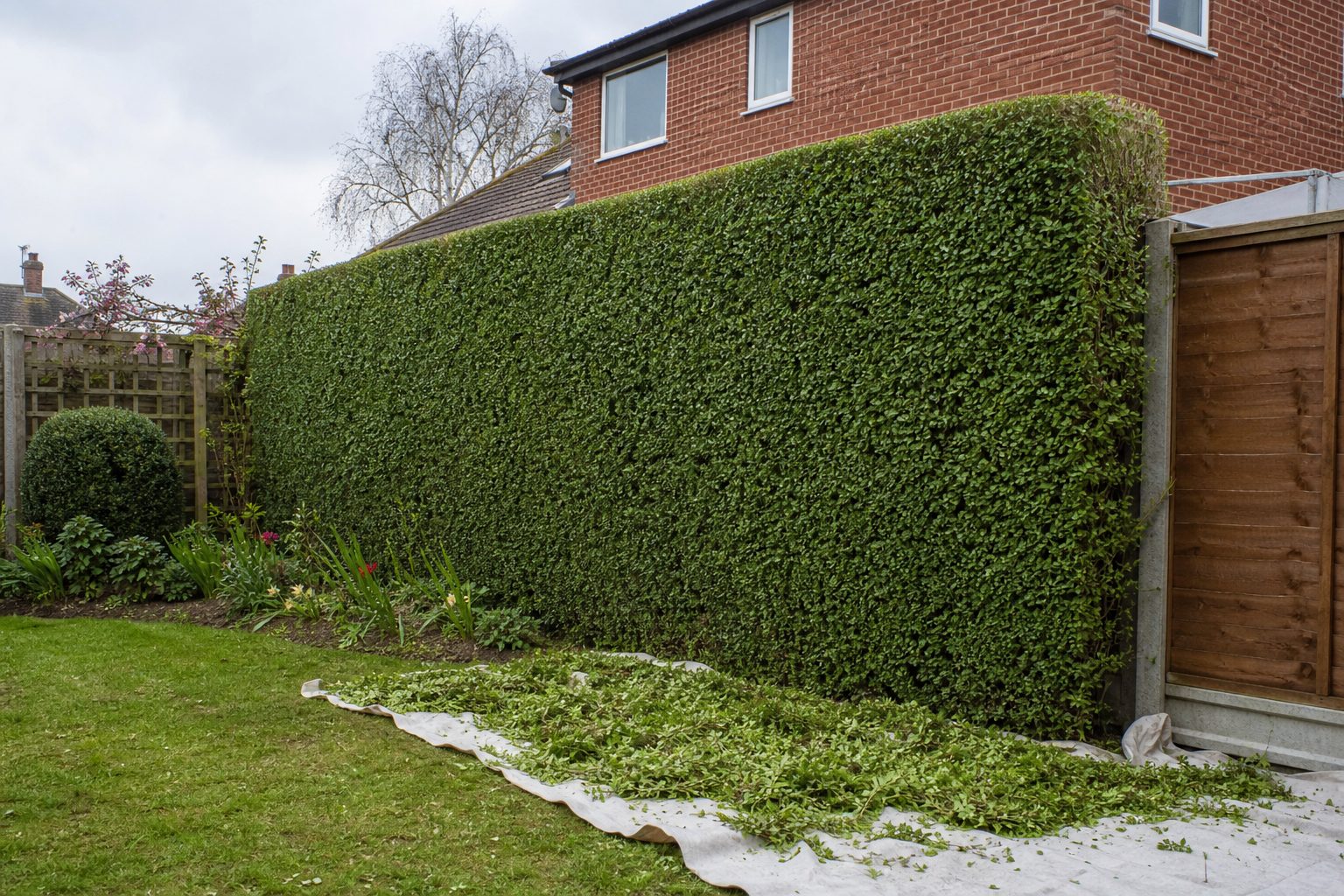
Clippings are collected onto sheets, loaded and removed by a registered waste carrier, or bagged and left if you would rather use your own green bin over the following weeks. The finish should be square, with sides tapered very slightly inwards towards the top so light reaches the base and the hedge stays green all the way down. Hedges cut with vertical or flared sides thin out at the bottom within a few years, which is the most common reason an old hedge looks bare underneath. Larger hedge jobs pair naturally with a clearance or a tidy-up in the same visit.